Beyond the T+2: Why Hong Kong’s 2026 Digital Listing Pivot Changes Everything
For decades, the global financial system has been held hostage by the rigid boundaries of the trading bell and the archaic multi-day settlement cycle. While the digital age moves at the speed of light, traditional equity remains tethered to the "T+2" model—a legacy of physical paper certificates and localized market hours. However, a fundamental re-architecting of global capital is underway.
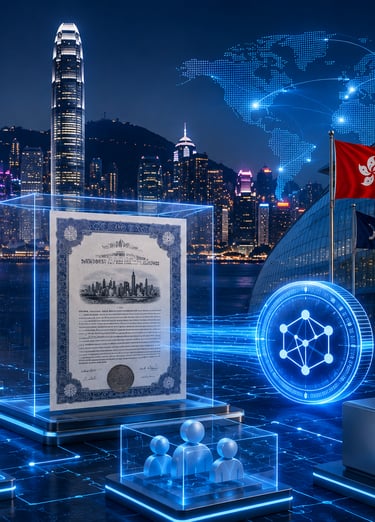
On April 20, 2026, a landmark circular from the Securities and Futures Commission (SFC) signaled the arrival of the "Digital Secondary Listing" (DSL) framework. This is not merely a gesture toward the crypto industry; it is a sophisticated "Parallel Listing Channel" (平行合规通道) designed to merge the 24/7 liquidity of blockchain with the regulatory rigor of a top-tier financial hub. With a consultation paper set for Q3 2026 and an official pilot launch in Q4 2026, Hong Kong is transitioning from "permitting" digital assets to becoming the world's premier gateway where global equity is re-imagined as a programmable, institutional-grade asset.
Takeaway 1: Not a "Token Launch," but a "Digital Mirror"
The DSL framework introduces the concept of "存量股权代币化" (Tokenization of existing shares). Crucially, this is a "zero-dilution" model. It is not about issuing new "coins" or secondary stock that dilutes existing shareholders. Instead, it creates a digital mirror of assets that already exist in the traditional market.
The Dual-Layer Architecture: Security by Design To ensure institutional-grade security and prevent the "decoupling" (脱钩) of assets, the framework utilizes a strict two-tier structure:
The Bottom Layer (Custody): The issuer’s existing traditional shares are held in custody by established licensed financial institutions, such as HSBC or Bank of China (BOC). This provides the "Real-World Asset" (RWA) primacy required by institutional mandates.
The Middle Layer (Mapping): A licensed Special Purpose Vehicle (SPV) issues the Security Token Offering (STO). This tokenized equity is a 1:1 mapping of the custodial shares, ensuring that the token carries identical rights—dividends, voting power, and economic interest—as the underlying stock.
Analysis: This model removes the most significant barrier to entry for listed companies. By focusing on "token compliance" rather than a full re-audit of business fundamentals, the SFC has reduced the vetting complexity to a "Medium" level, allowing firms to enter the Web3 ecosystem without the legal friction of a new IPO. As the SFC maintains: "Same business, same risks, same rules."
--------------------------------------------------------------------------------
Takeaway 2: The Death of the Trading Clock (24/7/365 Liquidity)
The most disruptive impact of DSL is the shift from the traditional T+2 settlement cycle to T+0 "second-level" settlement.
Under this framework, while a company’s traditional shares continue to trade on the HKEX Main Board during standard hours, their tokenized counterparts trade on licensed Virtual Asset Service Providers (VASPs) like HashKey or OSL.
Institutional-Grade Syncing To prevent market fragmentation, the framework mandates a price anchoring mechanism powered by the interconnection between VASP systems and the HKEX CCASS (Central Clearing and Settlement System). This real-time synchronization ensures that the digital and traditional versions of the share move in lockstep. If a price gap emerges, the system facilitates immediate arbitrage to maintain equilibrium.
Analysis: 24/7 trading is a game-changer for global investors. By removing the constraints of time zones and weekend closures, Hong Kong provides a continuous liquidity pool that reflects real-time global sentiment. This isn't just a technical upgrade; it's the realization of a global, always-on capital market.
Takeaway 3: The 6-Billion-Dollar Club (High-Quality Issuer Thresholds)
Hong Kong is not opening the digital floodgates to speculative startups. The DSL framework is explicitly designed for established, high-quality issuers, aligning its entry requirements with the traditional secondary listing standards established in the March 2026 Review.
Eligibility Criteria for Issuers:
Primary Listing: Must be listed on the HKEX Main Board (including 18A/18C firms), the Nasdaq, or the New York Stock Exchange (NYSE).
Listing History: A minimum of two years of compliant listing history.
Market Capitalization: A minimum market cap of HKD 6 billion.
Comparison: Traditional vs. Digital Listing (2026 Pilot)
Feature
Traditional Secondary Listing
Digital Secondary Listing (DSL)
Asset Format
Traditional Dematerialized Shares
Tokenized Equity (Security Token)
New Financing
Often requires new share issuance
No new issuance (Existing shares only)
Vetting Level
High (Full Prospectus/Audit)
Medium (Focus on Token Compliance)
Settlement
T+2 (Working Days Only)
T+0 (24/7/365)
Access
Retail & Institutional
Professional Investors (PI) Only
Takeaway 4: The "Professional Only" Safe Haven
The SFC is prioritizing "Regulatory Sandbox maturity" over retail hype. Participation in the DSL market is strictly limited to Professional Investors (PI) to ensure market stability during the initial pilot phase.
Financial Thresholds for Participation:
Individual Investors: Must hold a minimum of HKD 8 million in net assets, OR demonstrate an average annual income of at least HKD 2 million over the last three years.
Institutional Investors: Must hold a minimum of HKD 40 million in net assets.
Analysis: This prudent approach allows the infrastructure to be battle-tested by sophisticated players before any potential expansion. By enforcing these thresholds, the SFC is building long-term trust, positioning Hong Kong as the "Safe Haven" for regulated digital finance.
Takeaway 5: The Strategic "U-Turn" for US-Listed Chinese Firms
The most profound geopolitical implication of the DSL framework concerns "China Concept Stocks" (中概股). As of 2026, over 400 Chinese companies remain listed in the U.S., many facing delisting risks or high costs of returning to Asian markets.
DSL offers these firms a "low-cost, no-new-financing" (不融资、仅流通) back door. Because the model tokenizes existing shares rather than requiring a capital-intensive IPO, it provides a high-efficiency path to tap into Asian liquidity.
Financial Secretary Paul Chan, speaking at the April 2026 Web3 Carnival, articulated a vision of a "Dual-track" market. By linking Western capital structures with the emerging Web3 economy through a regulated digital pipe, Hong Kong is reclaiming its role as the ultimate "Super-Connector."
Conclusion: The Super-Connector Future
Hong Kong’s 2026 Digital Secondary Listing pivot is a signal that the city is positioning itself as the world’s only regulated gateway between traditional capital and the on-chain economy. By treating tokens as securities rather than separate "crypto" entities, the DSL framework provides a compliant path for the world’s largest companies to modernize their equity.
It is essential to view DSL as a supplement, not a replacement, for traditional listings. It provides a layer of efficiency and global accessibility that the legacy system simply cannot match.
As the pilot officially kicks off in Q4 2026, we must ask: Is the "Security Token" destined to become the default format for all global equity by the end of the decade? If the Hong Kong roadmap is any indication, the transition from the trading bell to the blockchain is already irreversible.